Document Processes - The Delivery Playbook Generator
There is a version of your business that runs without you being the answer to every question. Where a new team member can be onboarded without you shadowing them for a week. Where clients get a consistent experience regardless of who handles their account. Where you can take a holiday and come back to a business that has been managed, not just survived.
That version of a business is built on documented processes. And the reason most small businesses never get there is not a lack of intention. It is a lack of a practical starting point.
This post walks through why process documentation matters, what a useful process document actually contains, and how to use the free Chase Hunt Delivery Playbook Generator to get your first process documented today.
Why Small Businesses Don't Document Their Processes
Most of you know, at least in the back of your mind, that you should be writing down how things get done. The problem is that it never feels urgent enough to actually do. When you are running the business, doing the work, managing the team, and handling clients all at once, sitting down to write a process document feels like a luxury reserved for a calmer season.
That calmer season rarely arrives.
The result is a business that depends entirely on one or few people knowing everything. Every process lives in their heads. Every exception requires a judgement call that only you can make. Every new hire needs you to personally show them the ropes. Every client interaction gets shaped by whoever happens to be available that day, rather than a consistent standard the whole team follows.
This is an operational frustration that can seriously limit your growth. A business that cannot be handed off, even partially, cannot scale. It cannot be sold. It becomes the jail of your own creation.
Business process documentation is the first step toward changing that. And it does not have to be as hard or as time-consuming as most people assume.
What Is Process Documentation?
Process documentation is the practice of writing down, clearly and specifically, how a repeatable task or workflow gets done in your business.
It is different from a task list or a project plan. A task list tells you what to do once. Process documentation tells anyone in your business how to do something correctly, every time, to a defined standard.
Good business process documentation answers four questions:
- What gets done, step by step? Not at a surface level, but with enough detail that someone unfamiliar with the task could follow it without asking questions.
- Who does each part? Which role is responsible for each step, and where do handoffs happen between people?
- What tools and resources are needed? Templates, software platforms, reference documents, logins. Whatever someone needs to actually execute the step.
- What does done well look like? Quality markers, common mistakes to avoid, and edge cases that need a different approach.
Most business process templates stop at the first question. The ones that actually get used day to day answer all four.
What Processes Should You Document First?
If you are starting from scratch, the most valuable processes to document first are the ones where inconsistency is currently costing you something. Common starting points for small businesses include:
Client delivery processes. How do you onboard a new client? How do you deliver your core service? What happens at the end of an engagement? These are the processes that most directly shape client experience and your reputation in the market.
Internal operations. How are new team members inducted? How is work allocated and tracked? What happens when someone is unavailable? Documenting these reduces your dependence on key people, including yourself.
Finance and administration. How are invoices raised and followed up? How is monthly reporting completed? What is the approval process for expenses? These are the processes that most often cause problems when they go undocumented.
Sales and marketing workflows. How does a lead get followed up? What happens after a discovery call? How are proposals prepared and sent? Consistent processes here directly affect revenue.
A useful rule of thumb: if you have had to explain how something is done more than twice, it belongs in a process document.
Why Most SOP Templates Do Not Work for Small Business
Standard operating procedure templates are easy to find online. The problem is that most of them are designed for larger organisations with dedicated operations teams. They are dense, they are bureaucratic, and they are structured in a way that feels more like compliance documentation than a practical guide a small business team would actually pull up and use.
The result is that small business owners either find them overwhelming and abandon the whole project, or they push through and create a document that sits in a folder and gets read by nobody.
What small businesses actually need from a process document is something that:
- Is structured enough to be genuinely useful but simple enough to maintain over time
- Captures not just the steps but the context and the standard behind them
- Is written in plain language the team can follow without translation
- Can be created in a focused session rather than a week-long documentation project
- Produces an output that looks professional enough to take seriously
That is exactly what the Delivery Playbook Generator is designed to produce.
Introducing the Chase Hunt Delivery Playbook Generator
The Delivery Playbook Generator is a free, browser-based tool that guides you through documenting any business process step by step and produces a clean, printable playbook you can hand to a team member, file in your operations folder, or use as the basis for onboarding.
It is part of the Chase Hunt Business Operating System, a suite of free tools designed to help small business owners build the systems, visibility, and clarity they need to grow without becoming the bottleneck in their own business.
What the tool covers
The generator walks you through five steps.
Step 1: The Process. You name the process, select the category it belongs to (client delivery, internal operations, sales and marketing, or finance and admin), note who currently runs it, and indicate how often it runs. Naming a process precisely matters more than it sounds. "Client onboarding" is a more useful starting point than "onboarding", and "monthly financial reporting" is more actionable than "reporting".
Step 2: The Why. Before you document the steps, you define the standard. What goes wrong when this process is not followed? What does a great outcome actually look like? This step exists because the most common failure in business process documentation is writing down what happens without capturing what should happen. The standard is the whole point.
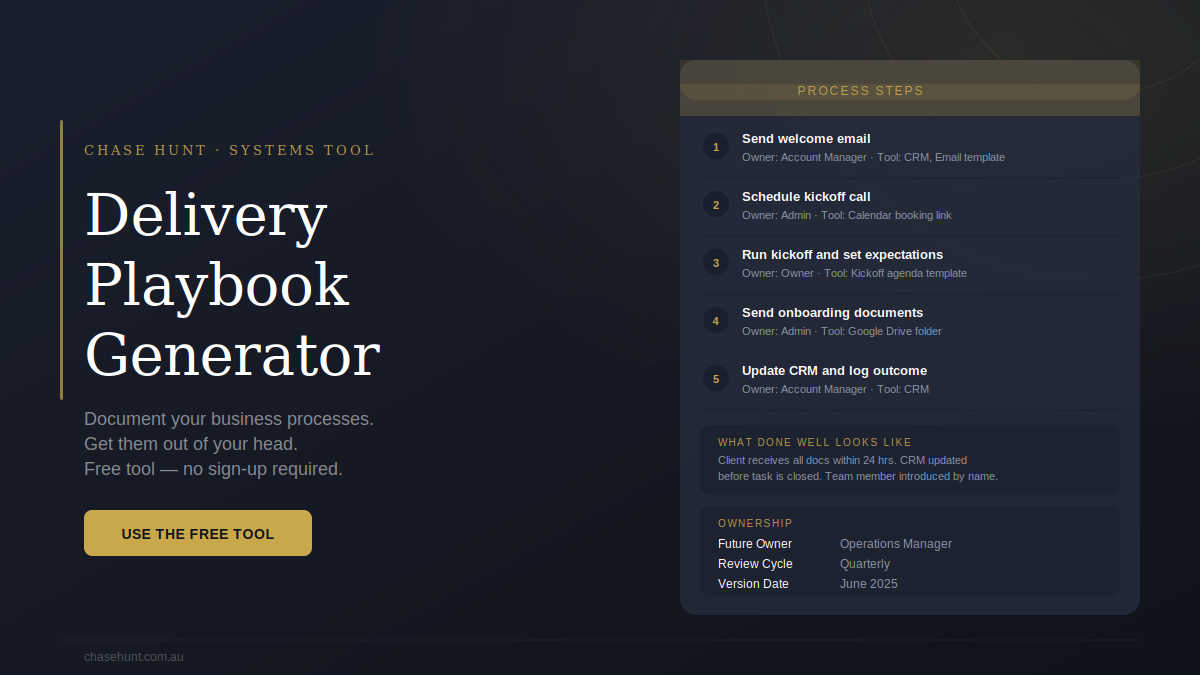
Step 3: The Steps. This is the core of the playbook. You document each step with a title, a description of what gets done, who does it, and any tools or resources required. The tool supports up to 20 steps, with a prompt at step 15 suggesting you consider whether a longer process might be better split into two separate playbooks. If you find it hard to get started, the built-in AI assist feature lets you describe the process in plain English and drafts the steps for you to review and edit from there.
Step 4: Standards and Edge Cases. This is the section most business owners skip, and it is where most of the value lives. What does done well look like? What are the common mistakes? Are there exceptions or situations that need a different approach? This is the institutional knowledge that usually lives only in the owner's head. Capturing it is what turns a checklist into a playbook.
Step 5: Ownership and Review. Who owns this process going forward? How long should it take when run correctly? How often should the playbook be reviewed and updated? A process document without a named owner is just a file. Assigning it and scheduling a review cycle turns it into a living part of how the business operates.
The output
At the end of the five steps, the tool generates a formatted Delivery Playbook. It is a professional document you can print to PDF, share with your team, or file in your operations system. It includes all the key details including process name, category, current and future owner, frequency, and version date, alongside the why section, the numbered steps with their supporting detail, the quality standards, and any edge cases worth noting.
It is designed to be something a real team member would actually open and follow, not a dense reference manual that gets filed and forgotten after day one.
How to Get the Most Out of the Tool
Do one process at a time. When people start a documentation project, the temptation is to try to capture everything at once. Resist it. Pick the single most important process, the one where inconsistency is currently costing you the most, and document that one first. A completed playbook for one process is worth more than a half-finished project covering ten.
Be specific with the step descriptions. The most common mistake in business process documentation is writing steps that are too high-level to be useful. "Send the welcome email" is not a useful step. "Send the client the welcome email using the template saved in the Client Onboarding folder, cc the account manager, and log the send date in the CRM" is a useful step. Write for someone who has never done this before.
Do not skip the standards section. The steps tell the reader what to do. The standards section tells them how well to do it and what to watch out for. This is where experienced knowledge gets transferred from the person who has always done it to the person who is doing it for the first time. It is almost always the section that separates a functional playbook from one that is genuinely useful.
Assign it before you file it. Every playbook should have a named owner before it goes anywhere. That person is responsible for following it, keeping it current, and flagging when something in it is no longer accurate. Without a named owner, even a well-written playbook will drift out of date.
Review it after the first use. The first time a team member works through a new playbook without your involvement, ask them to note anything that was unclear, missing, or did not match reality. The first version of any process document is a draft. The second version, updated after real-world use, is the one worth keeping.
The Bigger Picture: Building a Business That Runs on Systems
A single playbook is a meaningful step. It reduces the number of decisions that only you can make, raises the consistency of how your work gets delivered, and starts the process of making the business less dependent on you personally.
But one playbook is not a system. A business that gives you genuine freedom requires documented processes across every major area of how it operates: how work is delivered, how the team functions, how clients are managed, how the finances are tracked, and how decisions get made without the owner being in the room.
That is what the Chase Hunt Business Operating System is designed to help you build. The Delivery Playbook Generator is one tool in a larger suite. Each one is free. Each one produces a tangible output you can use straight away.
If you are at the point where you want to build this more systematically, a discovery call is the right next step. We can look at where the gaps are, which processes are most urgent to document, and what a properly systematised business looks like for your specific situation.
Frequently Asked Questions
What is a delivery playbook? A delivery playbook is a documented process guide that captures the steps, roles, tools, standards, and edge cases for a specific repeatable task in your business. It is designed to be followed by a team member to ensure consistent, high-quality execution without the owner needing to be involved every time.
How is a delivery playbook different from an SOP? Standard operating procedures and delivery playbooks serve the same fundamental purpose: capturing how a process gets done. The difference is mostly in format and approach. SOPs tend to be formal, compliance-orientated documents suited to larger organisations. A delivery playbook is structured for practical day-to-day use in a small business. It is more readable, more direct, and focused on capturing not just the steps but the standard and the context behind them.
How long does it take to document a process using the tool? For a straightforward process, most owners complete the tool in 15 to 25 minutes. More complex processes with many steps or significant edge cases may take closer to 45 minutes. The AI assist feature on Step 3 can meaningfully reduce the time spent on the most effortful part, which is writing out the individual steps.
How many steps can a playbook have? The tool supports up to 20 steps per process. At 15 steps, the tool prompts you to consider whether the process might be better split into two separate playbooks. If a process genuinely requires more than 20 steps, it is likely two distinct processes that would each benefit from their own documentation.
Do I need to sign up or create an account? No. The Delivery Playbook Generator is completely free and requires no sign-up. Everything runs in your browser. No data is stored or sent anywhere. You generate the playbook and print or save it as a PDF directly from the tool.
Can I use the tool for any type of business process? Yes. The tool covers four categories: client delivery, internal operations, sales and marketing, and finance and administration. It is suitable for any small business regardless of industry, whether you are in professional services, trades, retail, hospitality, or health and wellness.
What should I do after documenting a process? Assign an owner, file the playbook somewhere your team can access it, and schedule a review date. The first time the playbook is used without your direct involvement is the best time to review and refine it. After that, set a recurring review cycle. Quarterly works well as a starting point for most operational processes.
My business is just me. Is this still useful? Yes, particularly if you are planning to grow. Documenting your processes while you are a sole operator captures the way you work at your best, creates the foundation for delegation when you do bring someone on, and makes onboarding a contractor or employee significantly easier when the time comes. It also forces clarity on your own thinking about how work should get done, and that has real value in itself.
The Chase Hunt Delivery Playbook Generator is a free tool from Chase Hunt, a fractional COO advisory practice helping Australian small business owners build the systems, structure, and clarity they need to grow.
