Chase Hunt Business Planner
Free Business Plan Template for Small Business Owners
If you run a small business and don't have a written plan, you're not alone, but it's costing you more than you think.
Most small business owners in Australia have a clear picture of where they want to take their business. Very few have written it down in a way that actually guides their decisions week to week.
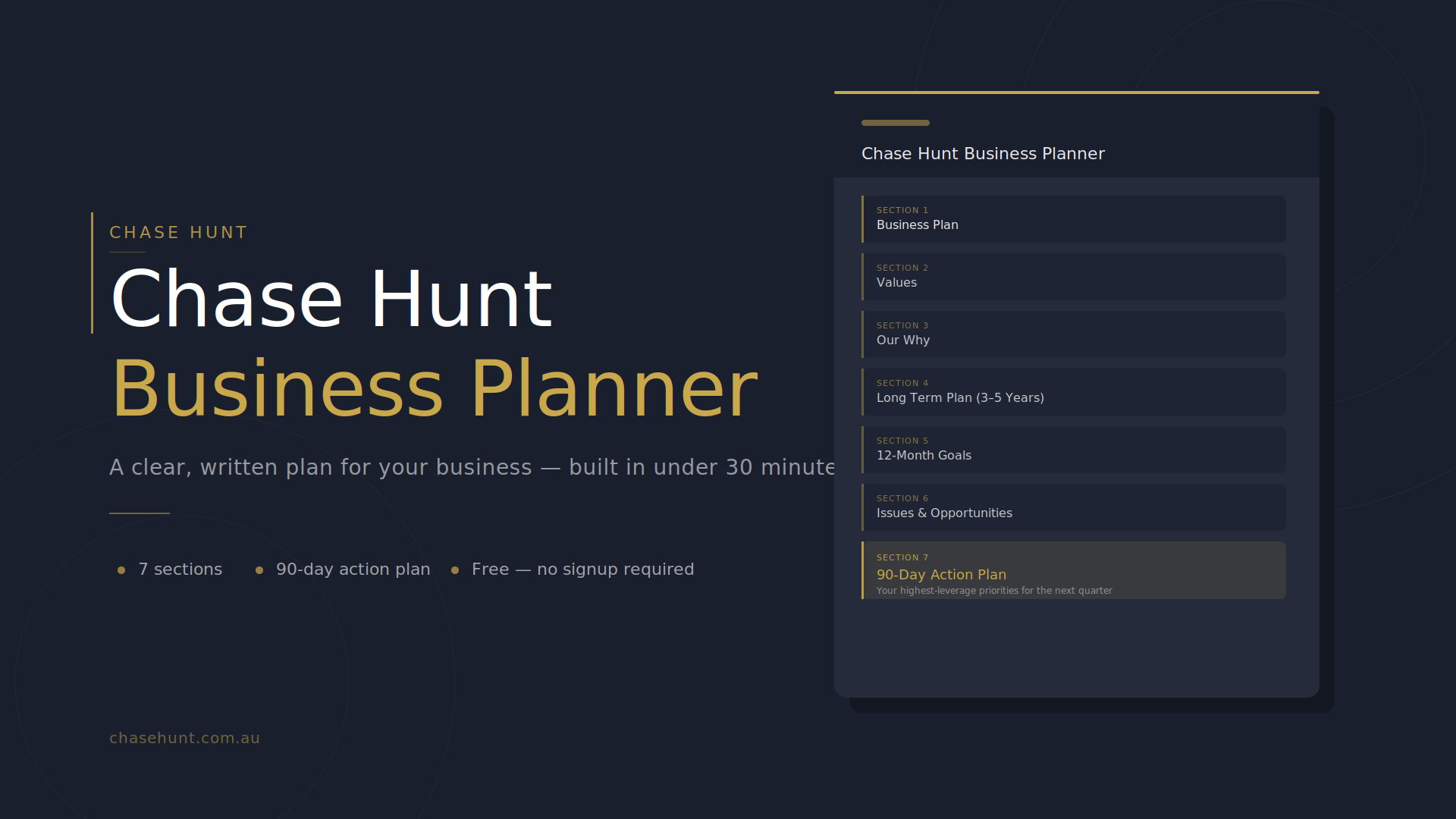
The Chase Hunt Business Planner is a free online tool that changes that. It walks you through seven focused sections and produces a clean, printable business plan in under 30 minutes. One you will actually look at and use.
No signup required. No download. Free.
Why most small business plans don't work
When most people hear "business plan", they picture a lengthy document written for a bank or investor, something that takes weeks to produce, gets filed away immediately, and is out of date before it's finished.
That's not what a useful small business plan looks like.
A plan that actually works for a working business owner needs to be short enough to finish in one sitting, specific enough to guide real decisions, and structured to be reviewed regularly.
The Chase Hunt Business Planner is built around that reality. It's not a document for an audience. It's a tool for you.
What is the Chase Hunt Business Planner?
The Chase Hunt Business Planner is a free online business planning tool designed specifically for Australian small business owners. It covers seven key sections and generates a formatted, printable summary when you're done.
It takes under 30 minutes to complete. Each section is structured with clear prompts, practical examples, and short input fields that keep you focused on what actually matters.
The output is not a 40-page document. It's a concise plan that covers your direction, your goals, your current issues, and your next 90 days of priorities in a format you can share with your team, print and put on your wall, or revisit every quarter.
How does the Business Planner work? A section-by-section breakdown
Here is exactly what the tool covers and why each section is included.
Section 1: Business Plan
The first section asks you to articulate what your business does, who it serves, and what it is working toward, in two to four sentences.
That constraint is deliberate. If you can't describe your business clearly in a few sentences, that clarity gap will show up everywhere: in your marketing, your hiring, your sales conversations, and your ability to delegate. Getting this right at the top of the plan creates the foundation for everything that follows.
You'll also record your business name, year founded, and industry to anchor the plan and appear in your printed output.
Section 2: Values
Your business values are the non-negotiables that should guide every decision, every hire, and every client relationship. Done well, they function as a practical filter.
This section asks you to name three to five values and describe what each one looks like in practice. That behavioural description is the important part. "Honesty over comfort — we tell clients what they need to hear, not what they want to hear" is a value you can actually use. "Integrity" on its own is not.
Section 3: Our Why
Two of the most important strategic questions in business: what specific problem do you exist to solve, and who exactly do you solve it for?
The more precisely you can answer these, the easier everything downstream becomes. Vague answers here produce vague marketing, vague positioning, and vague client selection. Clear answers create a filter that sharpens every decision.
Section 4: Long Term Plan (3 to 5 Years)
This is where you commit to a concrete vision for where the business is going. This is not a general aspiration; it is a specific picture with a date, numbers, and a description of your role at that point.
What is the revenue target? What is your profit margin? How big is the team? And critically, what are you doing day to day in the business at that point, and what have you stopped doing?
Business owners who complete this section honestly often find it more confronting than they expected. Describing where you want to be in five years makes very clear how far you currently are from it and whether what you're doing today is actually building toward it.
Section 5: 12-Month Goals
The long-term plan sets the destination. The 12-month goals define the next leg of the journey.
This section sets measurable targets for the year ahead — revenue, profit margin, team size, and three to five specific objectives that will move the business toward the long-term plan. Each objective should be specific enough that, at year's end, you can say clearly whether it was achieved or not.
You also set an end date for this 12-month cycle. That date becomes your next planning trigger.
Section 6: Issues and Opportunities
This is the section most business planning frameworks miss, and it's the one that makes the 90-day action plan actually useful.
The problems your business is currently facing are not just obstacles. They are your biggest opportunities for growth. Every issue that goes unnamed and unaddressed is a ceiling on what you can build.
This section asks you to list every issue the business is currently dealing with and anything getting in the way of your 12-month goals. Capacity constraints. Team gaps. Clients you're carrying. Systems that don't exist. Decisions that keep getting deferred. The more honest and complete this list is, the better.
Naming problems clearly is, in itself, a meaningful step. You can't solve what you haven't properly identified.
Section 7: 90-Day Action Plan
Your Issues and Opportunities list becomes the raw material for your 90-day plan.
This section asks you to identify your three to five highest-leverage priorities for the next quarter. Ideally the actions that directly address your most significant issues. Each priority needs a clear description of what 'done' looks like, an owner, and an estimate of the business impact.
Not every issue needs to be resolved in 90 days. The point is to choose the priorities that will move the business forward most right now and commit to them. A focused 90-day plan beats a long list of intentions every time.
You set a specific end date for this cycle. That date is your review trigger, the prompt to run through the planner again, update your answers, and reset your priorities for the next quarter.
What does the output look like?
When you complete all seven sections, the tool generates a clean, formatted summary of your business plan. You can print it directly from your browser or save it as a PDF.
The output is designed to be used. Keep it somewhere visible. Share it with your leadership team. Bring it to team meetings. Use the 90-day end date as the prompt to review and refresh it each quarter.
The rhythm of 90 days of focused execution, a review, and a reset is what keeps the plan alive and useful. The first time through takes under 30 minutes. Each quarterly review takes less.
Who is this business planning tool for?
The Chase Hunt Business Planner is useful for any small business owner who:
- Has a general sense of where they want to go but has never written it down properly
- Feels like they're working hard but isn't confident they're working on the right things
- Has tried formal business planning before but found it too slow, too complex, or too disconnected from the day-to-day
- Wants to move from reactive to deliberate (from responding to what comes at them to building toward something specific)
- Runs a team and wants everyone working from a shared, clear picture of the direction and near-term priorities
- Is a solo operator who wants a structured framework to think through the year ahead
It's particularly well-suited to service-based businesses, trade and construction businesses, professional services firms, and owner-operated businesses at any stage of growth.
Frequently asked questions
- How long does it take to complete the Business Planner? Under 30 minutes for most business owners. Each subsequent quarterly review takes less time, because you're updating an existing plan rather than starting from scratch.
- Is the Chase Hunt Business Planner really free? Yes. No signup, no credit card, no download required. Open the tool in your browser and start.
- Do I need to complete all seven sections in one sitting? The tool is designed to be completed in one sitting so that you produce a complete, connected plan — but you can return to it and work through sections across multiple sessions if needed.
- Can I share the output with my team? Yes. The output can be printed or saved as a PDF, making it easy to share with a business partner, leadership team, or business advisor.
- How often should I update my business plan? The tool is structured around a 90-day review cycle. Every quarter, revisit the planner, update your goals and priorities, and reset your 90-day action plan. The long-term plan and values sections will need updating less frequently — typically once a year.
- Is this tool suitable for a solo operator? Yes. The prompts and examples in the tool reflect the realities of running a business without a large team. Solo operators will find the 90-Day Action Plan and Issues and Opportunities sections particularly useful.
- What makes this different from a standard business plan template? Most business plan templates are designed to satisfy an external audience — a bank, an investor, a grant application. The Chase Hunt Business Planner is designed for the business owner. It focuses on clarity, direction, and near-term execution rather than financial modelling or market research reports.
A note on honesty
The planner works in proportion to how honest you are with it.
The Issues and Opportunities section and the long-term role description are the ones where business owners are most tempted to write the polished version (the answer they think they should give rather than the true one).
Resist that. This plan is a tool for you, not for an audience. The more accurately it reflects where things actually are, the more useful it becomes. A plan built on a flattering picture of reality will not help you navigate real conditions.
Use the free Business Planner
The Chase Hunt Business Planner is free, takes under 30 minutes, and produces a plan you can actually use.
If your plan raises questions, or if you want to work through what it means for your specific business, I offer a free discovery call. No pitch, no pressure — just a conversation about where you are and whether working together makes sense.
Chase Hunt is a Sydney-based business advisor who works with Australian small business owners to build better businesses — ones that grow without the owner becoming the bottleneck. Learn more about working with Chase Hunt.